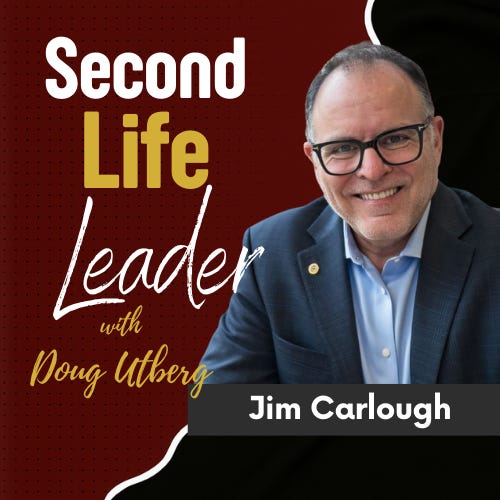
Healthcare executive and leadership author Jim Carlo joins me to unpack a deceptively simple idea: leadership isn’t granted by a title — it’s earned through trust.
In many organizations, the path to management still looks the same. A strong individual contributor performs well, gets promoted, and suddenly finds themselves responsible for leading people without any real preparation for what leadership actually requires.
This conversation explores what happens in that transition.
Jim Carlo reflects on 35+ years in the healthcare industry, including lessons from his earliest leadership roles where, by his own admission, he made many of the mistakes new leaders make. Moving from authority-based management to trust-based leadership is rarely immediate — it’s something leaders grow into through experience, humility, and reflection.
We talk through the psychological hurdles that show up when people step into leadership for the first time, including imposter syndrome and the pressure to immediately prove competence. Jim argues that the instinct to start talking and directing is often the wrong move. The most effective leaders begin by listening, observing, and learning how their teams actually operate.
The conversation also explores how leadership itself is evolving as organizations adapt to new technologies like artificial intelligence. While AI may automate processes and flatten hierarchies, the human dimensions of leadership — empathy, trust, emotional awareness, and stability — remain irreplaceable.
Where machines can optimize outputs, leaders must understand people.
Jim shares the framework he’s developing to help leaders earn the “right to lead,” built around principles like transparency, emotional intelligence, consistency, and integrity. These are not soft skills. They are the foundation of trust, and without trust, leadership collapses into authority without followership.
This episode is a candid discussion about leadership maturity, organizational culture, and why the most important skill for modern leaders may simply be learning how to show up — consistently, transparently, and human.
The lesson isn’t about commanding authority.
It’s about becoming someone people genuinely want to follow.
TL;DR
• Leadership is not granted by a title — it’s earned through trust
• New managers often struggle with imposter syndrome and overcompensation
• The best leaders begin by listening before directing
• AI may automate processes, but it cannot replace human leadership
• Emotional intelligence and empathy are becoming more important, not less
• Stability and consistency from leaders create psychological safety for teams
• Leadership development is a lifelong process, not a one-time promotion
Memorable Lines
“Leadership isn’t about authority — it’s about followership.”
“The first thing a new leader wants to do is talk. The best thing they can do is listen.”
“Integrity is non-negotiable. Without trust, leadership doesn’t exist.”
“AI can measure performance, but it can’t understand people.”
“Leadership evolves because people and environments evolve.”
Guest
Jim Carlo — Healthcare executive, leadership author, and speaker
A 35-year veteran of the healthcare industry, Jim has worked across insurance and healthcare technology while developing leadership frameworks designed to help organizations build trust-driven leadership cultures.
🔗 Website: jimcarlo.com
🔗 LinkedIn: Jim Carlo
Why This Matters
Many organizations still promote managers based on technical performance rather than leadership readiness. The result is predictable: talented professionals step into leadership roles without the tools or frameworks needed to lead effectively.
As technology reshapes how organizations operate, the human side of leadership becomes even more important. Teams need leaders who can create trust, interpret emotional signals, and maintain stability in uncertain environments.
Titles may grant authority.
But the right to lead is something people choose to give you.