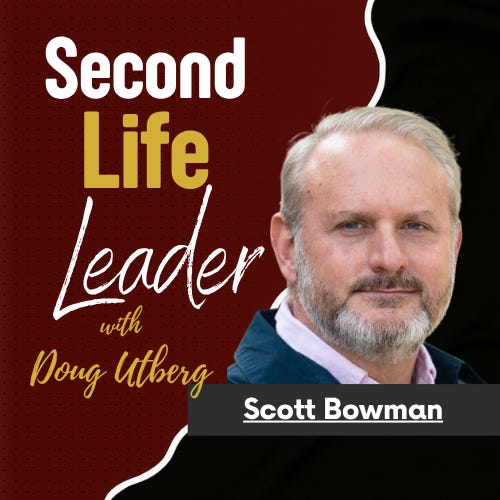
Scott Bowman joins me for a conversation that starts in finance—but quickly turns into something much bigger.
We unpack the transition from high-pressure investment banking to leading mission-driven companies focused on sustainability, second chances, and long-term impact.
Scott spent years inside the world of constant travel, deal-making, capital raises, and relentless growth. The work was financially rewarding—but eventually the deeper question showed up:
“What is all of this actually for?”
That question ultimately led him away from the traditional “mercenary” side of finance and toward organizations trying to build something more meaningful.
This episode explores the tension between profit and purpose—and why they don’t have to be opposites.
We talk about burnout, capitalism, leadership, private equity, sustainability, prison reform, supply chains, organizational culture, and the difference between creating value versus extracting it.
One of the most interesting parts of the conversation is Scott’s experience helping companies prove that mission-driven businesses can still grow, remain profitable, and scale successfully—without losing the human side of the work.
This isn’t a conversation about rejecting business.
It’s about redefining what successful business looks like.
TL;DR
• Burnout often hides behind ambition and achievement
• Leadership becomes hollow when purpose disappears
• Profitability and ethics can coexist
• Sustainable companies think beyond short-term extraction
• Great businesses create value instead of only maximizing returns
• Mission-driven cultures create stronger long-term engagement
• Second chances can completely change people’s lives
• Financial success means very little without meaning attached to it
Memorable Lines
“Money becomes a way to keep score.”
“You can make money and still build something meaningful.”
“The fastest way to make a lot of money is to steal it.”
“You start to wonder if there’s something more than chasing the next deal.”
“Good businesses create value. Extractive businesses take it.”
“Eventually you realize the work has to mean something bigger than yourself.”
Guest
Scott Bowman — CFO with a background in investment banking and mission-driven consumer brands
Formerly worked in middle-market investment banking before transitioning into leadership roles focused on sustainability, organizational culture, and long-term impact
Currently helping lead businesses centered around ethical growth, human sustainability, and community-focused operations
Why This Matters
A lot of high performers spend years climbing toward success without ever stopping to define what success actually means.
The external rewards keep growing.
The internal fulfillment often doesn’t.
That disconnect creates burnout, disengagement, and the feeling that work has become purely transactional.
What makes this conversation important is that it challenges the assumption that business must choose between profitability and humanity.
It doesn’t.
Organizations can grow while still investing in people, communities, sustainability, and long-term thinking.
But that only happens when leaders stop viewing business as a machine for extraction—and start viewing it as a system capable of creating lasting value.
That shift changes not only how companies operate.
It changes how people experience their work entirely.