What happens when rapid success becomes unsustainable?
For Colin Hodge, the answer came through a painful lesson.
After building a startup that reached 1 million users in roughly three months, Colin found himself under enormous pressure—scaling infrastructure, recruiting a team, experimenting with growth tactics, and dealing with a major trademark lawsuit. Then Apple told him his app would be removed from the App Store within 24 hours.
He eventually found himself sitting on the floor of his San Francisco apartment, overwhelmed and crying in the shower.
That moment became a turning point.
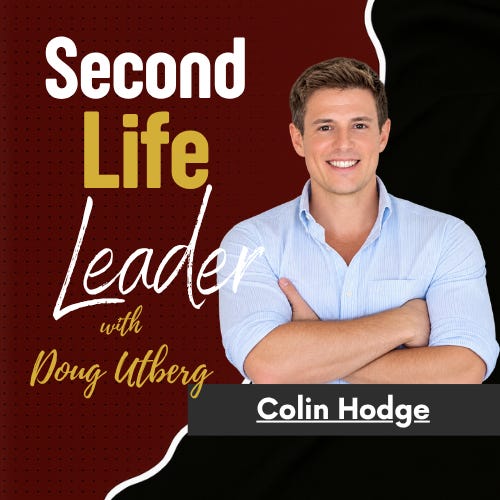
In this episode of Second Life Leader, Colin joins Doug Bird to talk about the psychology that helped him rebuild—not just his company, but his approach to entrepreneurship itself.
They explore what it means to get comfortable with discomfort, stop living for other people’s approval, understand customer psychology, and build systems that allow sustainable growth instead of frantic growth.
TL;DR
The psychology behind how you work may matter just as much as the strategy you’re using.
Colin’s biggest lessons include:
Get comfortable being uncomfortable.
Stop building your life around other people’s approval.
Be authentic without confusing authenticity with performance.
Understand your users’ psychology and meet them where they are.
Focus on the variables you can actually control.
Treat business decisions as hypotheses that need to be tested.
Don’t wait for perfection before putting ideas into the world.
Let data drive your decisions.
Build systems that allow small wins to compound over time.
The goal isn’t to swing for the fences every time.
It’s to develop the discipline to keep getting on base.
Memorable Lines
“I need to get comfortable with being uncomfortable.”
“The worst that happens is people see you’re trying.”
“I don’t have to perform for this.”
“It’s not lack of planning, it’s just lack of fakeness.”
“You can’t control the outcome. You can control the process.”
“What’s the hypothesis?”
“If you’re swinging always for the fences, then you need to take a hard look and be like, are you okay with the one out of a thousand going there?”
Guest: Colin Hodge
Colin Hodge is a repeat founder who has grown startups to millions of users and has experienced both rapid growth and painful setbacks.
His experience ultimately led him toward a more sustainable approach to entrepreneurship—one grounded in psychology, behavioral science, experimentation, and understanding the people using his products.
A major part of that approach is what Colin calls “decision engineering”: understanding the cognitive biases and psychological factors that influence the small decisions users make throughout their journey.
Why This Matters
Entrepreneurship often rewards the appearance of certainty.
Social media shows the successful launch. The funding announcement. The growth chart. The bestseller.
It rarely shows the breakdown in the shower.
But failure, uncertainty, and messy rebuilding are often part of the actual process.
Colin’s story is a reminder that sustainable growth isn’t necessarily about finding the biggest possible opportunity or constantly chasing the next growth tactic.
Sometimes it’s about understanding the game, identifying what you can control, testing your assumptions, and doing enough repetitions to learn what actually works.
As Doug puts it through the baseball analogy: focus on the strike zone, not the result of every swing.
Because in an uncertain world, you can’t guarantee every outcome.
But you can build a process that gives you a much better chance of creating the outcome you want.
Listen to the full conversation with Colin Hodge on Second Life Leader.